Social Media Search Engines in 2026: Find Posts and People
Parth Koshti


Founder @ SnitchFeed
A social media search engine lets you search public posts, or public profiles, across several social networks from one place. For posts and mentions, start with Social Searcher or Google's site: operator. For a username, use WhatsMyName or Sherlock. For an email or phone number, try FootprintIQ, and for a photo, Google Lens. If you need the same search every day, a monitoring tool like SnitchFeed, Hootsuite or Brand24 will run it for you and send alerts.
To test these, we searched for our own brand, "snitchfeed", on 9 October 2026, and checked every price and limit on each vendor's own site that day. Searching our own name kept the tests honest and avoided looking up a real person. Where a vendor doesn't publish a number, we say so. User quotes are public posts from Reddit, X and LinkedIn that we found with SnitchFeed, quoted as written.
Quick picks
- Social Searcher: free search for posts and mentions across networks, no account needed.
- Google
site:operators: the most flexible free way to search one network, or several. - WhatsMyName: free username search in your browser, across 700+ sites.
- Sherlock: free, open-source username search for the command line.
- FootprintIQ: free basic scan from a username, email or phone number.
- Google Lens: free reverse image search.
- SnitchFeed: keeps searching Reddit, X, LinkedIn, Bluesky and Hacker News for you (our product).
What are you trying to find?
Google's own answer for "social media search engine" ends by asking whether you're tracking a topic or looking for a person. That's the right first question, so start with what you have.
| You have | You want | Use |
|---|---|---|
| A keyword, brand or hashtag | Recent public posts that mention it | Social Searcher, Google site: operators, native platform search |
| A keyword, brand or hashtag | To be told about new posts, every day | A monitoring tool |
| A username | Every site where that username exists | WhatsMyName, Sherlock |
| An email address or phone number | Accounts linked to it | FootprintIQ, Epieos |
| A full name | That person's public profiles | Google with qualifiers, Social Catfish |
| A photo | Where else the image appears | Google Lens |
What is a social media search engine?
People use the term for three different things.
The first is post and mention search. You type a keyword and see public posts that contain it. Social Searcher, Talkwalker's Free Social Search and every platform's own search box work like this.
The second is people and profile search. You start from a username, email address, phone number, name or photo and look for matching public profiles. WhatsMyName, Sherlock, FootprintIQ and Social Catfish do this. Investigators call it OSINT (open-source intelligence), or SOCMINT when the source is social media.
The third is social listening, also called monitoring. You save a search once and the tool keeps running it, so you hear about new matches. SnitchFeed, Brand24, Hootsuite and Mention are in this group. If you only need an answer today, you don't need one.
Social media search engines compared
| Tool | Finds | What it searches | Free? | Sign-up |
|---|---|---|---|---|
| Social Searcher | Posts, mentions | Public pages in Google's index | Free, unlimited | No |
| Talkwalker Free Social Search | Posts, mentions, sentiment | Last 7 days, a "limited set of sources" | Free | Form, then emailed login |
Google site: operators | Posts, profiles | Any site Google has indexed | Free | No |
| X Advanced Search | Posts on X | X | Free | X account |
| Reddit search | Posts and comments on Reddit | Free | No | |
| Bluesky search | Posts on Bluesky | Bluesky | Free | No |
| LinkedIn post search | Posts on LinkedIn | Free | Usually | |
| Hacker News Search | Stories and comments on HN | Hacker News | Free | No |
| WhatsMyName | Accounts by username | 700+ websites | Free | No |
| Sherlock | Accounts by username | 400+ social networks | Free, open source | No, runs on your computer |
| FootprintIQ | Accounts by username, email or phone | "400+ public platforms" on paid tiers | Free basic scan | Not for a basic scan |
| Recosint | Profile links for a username | 45+ platforms (links only, not checked) | Free | No |
| Epieos | Accounts by email or phone | Google, Skype and more | Limited free plan | Yes |
| Social Catfish | People by name, email, username, phone, address or photo | "200+ trusted data sources" | Free preview, paid reports | For full reports |
| Google Lens | Where an image appears | The web | Free | No |
| SnitchFeed | New posts, continuously | Reddit, X, LinkedIn, Bluesky, Hacker News | 7-day trial | Yes |
| Hootsuite | Recent posts and trends | 7 days on Standard; Reddit and LinkedIn on Enterprise only | 14-day trial | Yes |
| Brand24 | New posts, continuously | Social, news, blogs, forums | 14-day trial | Yes |
Find posts and mentions
Social Searcher
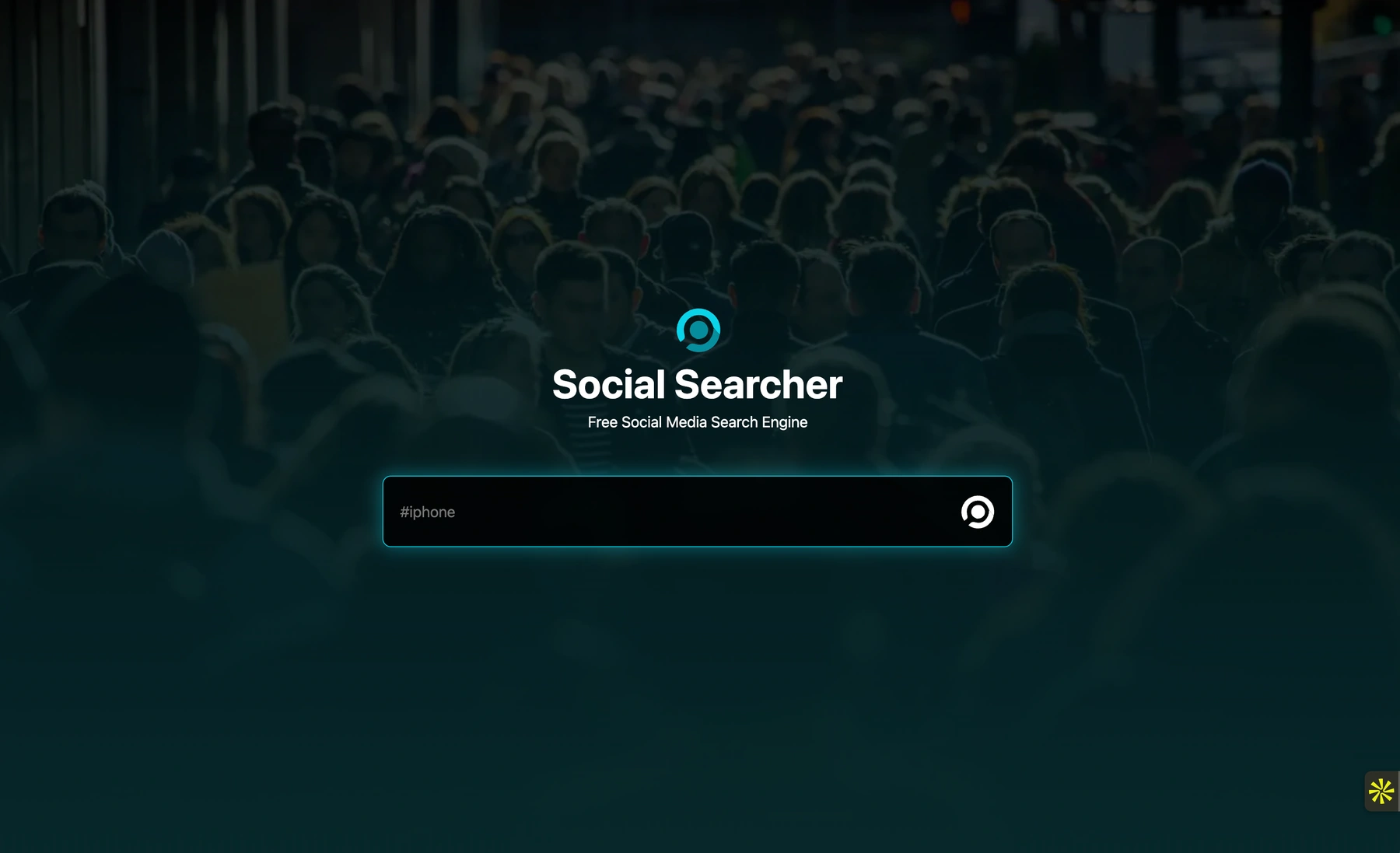
Google ranks Social Searcher first for "social media search engine", and for a quick look across networks it's the easiest place to start. There's no account and no paid plan. The site calls itself "completely free, private, and unlimited", and its old pricing page now returns a 404.
The catch is how it gets results. Social Searcher says it uses "embedded Google search engine technology" and doesn't collect data from the platforms or use their APIs, so you're seeing what Google has indexed. That's usually older, popular posts, not something posted an hour ago, and rarely comments. We didn't find saved searches or email alerts. (About Social Searcher)
Is Social Searcher legit? Yes. It's a real, free tool that only shows public results and says it doesn't store platform data.
Website: social-searcher.com
What users say about Social Searcher:
"Social Searcher is a social media search engine that indexes publicly available content across multiple platforms. Search by keyword, username, hashtag or phrase to locate posts, profiles and discussions relevant to an investigation."
Talkwalker Free Social Search
Talkwalker (now Lumen by Talkwalker, part of Hootsuite) gives away a cut-down version of its paid search. You get mentions, sentiment, engagement and influencers for a brand or hashtag, which is more analysis than any other free tool here offers.
It's narrow, though. "The free version includes seven days of data and a limited set of sources," and Talkwalker doesn't say which of its sources (Facebook, Instagram, Reddit, X, YouTube, blogs, forums, news) are included. You can't open it straight away either: you fill in a form and wait for an emailed login link. There are no saved searches or alerts. (Free Social Search)
Website: talkwalker.com
What users say about Talkwalker Free Social Search:
"I used Talkwalker Free Social Search. You have to sign up, but it is free to use."
"...big trend update accounts used talkwalker that gives inaccurate trends? the same accounts won’t even add countries that trend on twitter and sometimes don’t show up on talkwalker..."
Google site: search
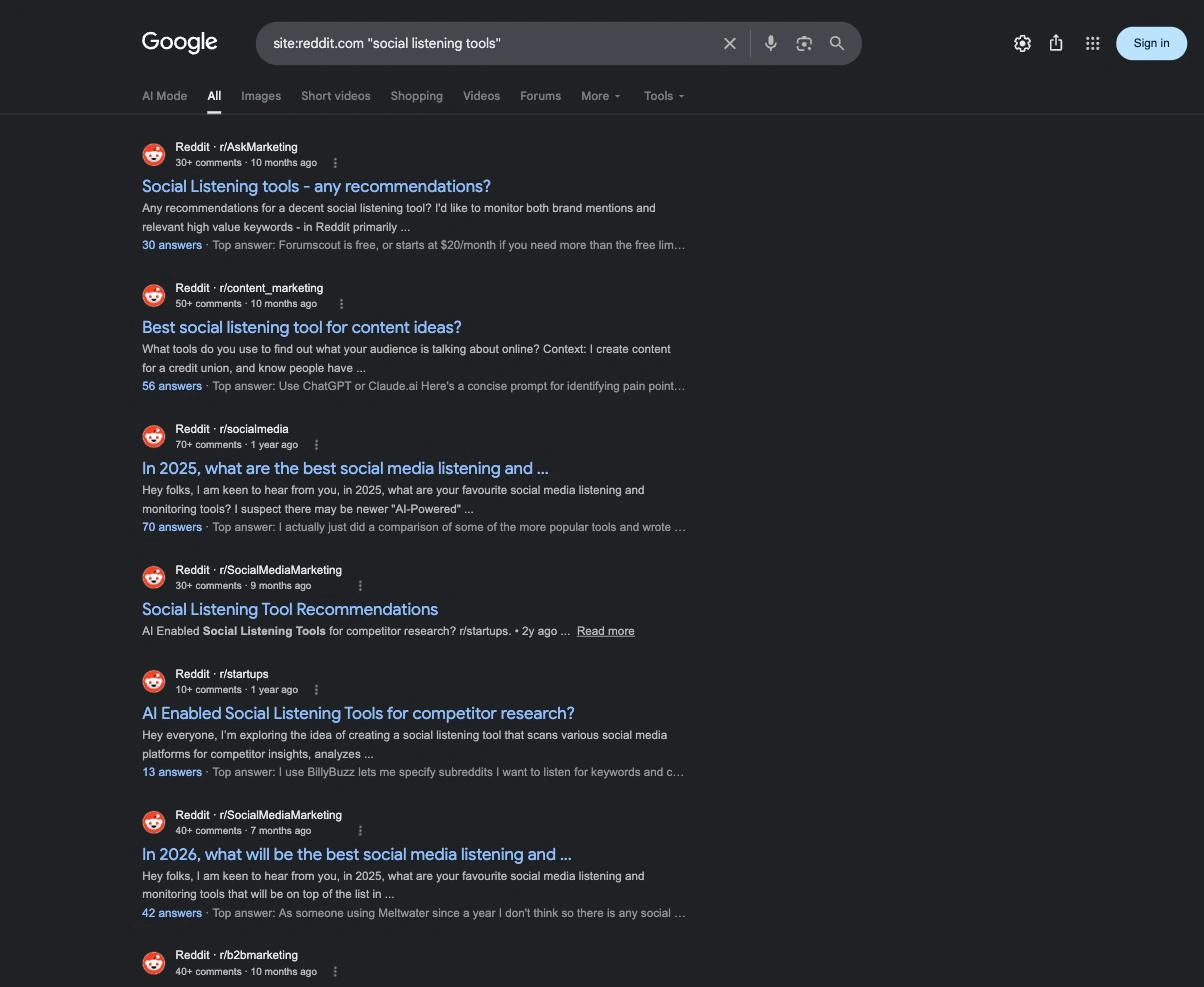
Most people already know this one, and it's still the most flexible free option. Put site: in front of a domain to keep Google's results to that site, and add your words in quotes. Google also supports - to exclude a word and before: and after: for dates:
site:reddit.com "your brand" -jobs
site:linkedin.com/in "product manager" "Berlin"
"your brand" (site:x.com OR site:bsky.app) after:2026-09-01
One thing our test showed: when we searched site:reddit.com "snitchfeed", Google returned no Reddit pages at all. It showed Slashdot, G2 and SourceForge listings instead. So check the URLs in your results before you assume a site mentioned you. Google's own documentation also says site: results are "not always exhaustive", and brand-new posts take time to be indexed. (Google search operators, site: operator docs)
What users say about Google site: search:
"To be fair, reddit search sucks. I use google with site:reddit.com/r/<where I want to look> instead."
"The reason so many of us were routinely appending "site:reddit. com" to those types of queries, was specifically to AVOID recommendations that involved affiliate links."
X Advanced Search
X's advanced search is free "when you're logged in to X.com", and it's still the best way to search X itself. You can filter by words, by accounts (from, to and mentioning), by date and by engagement. X Pro, the multi-column view that used to be TweetDeck, now needs Premium+. Our X advanced search builder writes the operators for you, and searching X without an account covers what you can do logged out.
If you were hoping to automate it, the X API is now pay-per-use, at $0.005 per post read, and its Recent Search endpoint only covers the last 7 days. (X Advanced Search help, archived, X API pricing)
What users say about X Advanced Search:
"x advanced search is a free lead machine. search your competitor's name next to "refund", "broken" or "anyone else". x shows you every person complaining about them."
"X advanced search has been broken for a month (had been deteriorating for a year or so). Grok can still find stuff, sorta."
Reddit search
Reddit's search has a bad reputation, and some of it is earned. It's more useful than most people think, though, because it has a Comments results type, so you can search what people said in threads, not just post titles. It also takes filters like subreddit:, author:, title:, site: and url:, plus AND, OR and NOT, and posts can be limited to the past hour, day, week, month or year. One quirk: comment results have to contain every word you typed. (How Reddit search works, search features)
If you'd rather use Google's ranking, Redditle is a free "Reddit-only Google Search" made for people who add "reddit" to every search. (Redditle)
We also built a free Reddit comment search. It searches posts and comments from the last 14 days by keyword, subreddit or username, and highlights the matching words.
What users say about Reddit search:
"Reddit search is very contested on this website because it sucks really really really bad. You could search for an exact title a lot of the time and it doesn’t come up"
Bluesky search
Bluesky is the easiest network to search. You don't need an account ("users that are logged out are also able to search Bluesky"), and it understands real operators: from:, to:, mentions:, domain:, lang:, hashtags, quoted phrases, and since: and until: for dates. (Bluesky search tips)
Our search for "snitchfeed" returned 4 posts going back to April 2025, all from our founder's account, so it isn't limited to recent posts. What it can't do is save a search or notify you about new matches.
What users say about Bluesky search:
"The search filter options for bluesky are supreme, I wish twitters advanced search was actually this quickly accessible"
"the search on this app is almost worse than the search on bluesky"
LinkedIn post search
LinkedIn's own search is the only way to search LinkedIn posts directly, and it's free but slow going. Run a search, click "See all results", then open the Posts tab. From there you can filter by date posted, content type, author, company, mentions and author industry, and use AND, OR and NOT in capitals. If you're not signed in, LinkedIn "may" ask you to sign in before you can keep going. (Search for member posts, Boolean search on LinkedIn) Our guide to LinkedIn social listening walks through it.
Hacker News Search
Hacker News Search, run by Algolia, covers stories and comments and is free. Put your term in quotes. When we searched snitchfeed without quotes we got 149 results, nearly all of them stories about people being "snitched" on. With quotes, we got none, which was the right answer. If you want new matches as a feed, hnrss.org turns a search into RSS. For what to search for, see Hacker News buying signals.
SearchAll
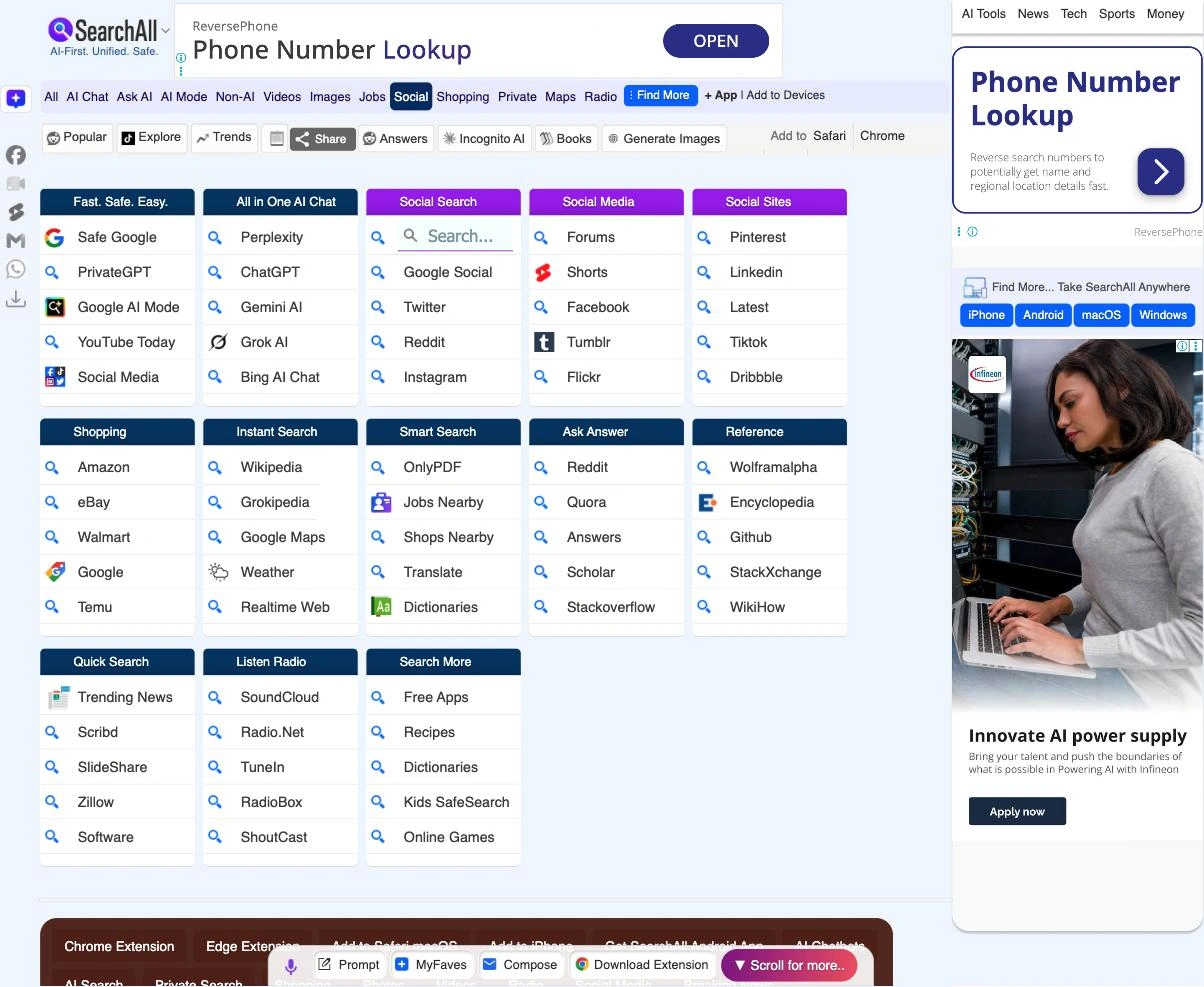
SearchAll says it lets you "search Facebook, Twitter, Instagram, Pinterest, Linkedin, Reddit directly". It's free and runs on ads. We couldn't confirm that it merges results into one list, so think of it as a launcher that opens each network's own search. (SearchAll)
Find a person's social media profiles
Everything in this section finds public information only. None of these tools can see private accounts, and none can prove two accounts belong to the same person. That's your job. Read privacy and legal limits first.
WhatsMyName
If you have a username and want to know where else it's used, WhatsMyName is the easiest free option. Type the name and it checks a community-maintained list of "700+ websites", then shows which ones have a matching account. There's no sign-up. The list is open data (CC BY-SA 4.0), kept up since 2015 by Micah Hoffman, and the web app is built by OSINT Combine. (WhatsMyName, dataset on GitHub)
A hit tells you an account with that name exists. It doesn't tell you who runs it.
Website: whatsmyname.app
What users say about WhatsMyName:
"If you don’t feel like messing with a terminal, just use WhatsMyName... Paste the handle in your browser, it checks a few hundred sites, done."
Sherlock
Sherlock does the same job from the command line. It's open source (MIT licence) and checks 400+ sites. Install it with pipx install sherlock-project and run sherlock username. (Sherlock on GitHub)
We ran sherlock snitchfeed. It took about 45 seconds and reported 8 accounts. Two we could confirm as ours (YouTube and DEV Community). The Periscope result redirected to our X profile. The mastodon.cloud result was a false positive that landed on an image page, and two sites blocked us from checking at all. It also didn't check X or LinkedIn directly. That's typical of username tools: treat every hit as a lead to open and check, not an answer.
Don't confuse it with Namechk. Namechk tells you whether a username is available to register on 90 to 100+ sites. Sherlock and WhatsMyName tell you whether an account with that name exists.
Website: github.com/sherlock-project/sherlock
What users say about Sherlock:
"One of my favorite OSINT tools on Kali Linux: Sherlock 🔎 You can look up a username to find accounts across multiple social media platforms and other popular sites"
"IME sherlock is mid, Ive manually went through and validated some of the "detectors" and the first few I checked had false positives."
FootprintIQ
FootprintIQ starts from a username, email address or phone number and returns matching public profiles with links and confidence scores. The basic scan is free, with no sign-up or card, but it only shows part of what it finds; FootprintIQ says the full "400+ public platforms" are on paid tiers. Pro is £119 a year for 100 scans a month, and a one-off Deep Scan is £24.99. It says it works from "publicly accessible data only". (Social media finder, pricing)
Website: footprintiq.app
Recosint
Recosint builds profile links for a username across 45+ platforms, along with ready-made Google searches and Wayback Machine links. It's free with no login. Read the small print, which is refreshingly honest: its links don't "confirm whether an account actually exists; manual verification is always required". (Recosint username search)
Epieos
Epieos looks up accounts linked to an email address or phone number. The free plan needs a sign-in, covers only a few modules (Google, Email Checker and Skype) and adds a watermark. For everything, including LinkedIn, the Osinter plan costs €29.99 a month for 30 full requests. Epieos says it doesn't save searches and doesn't alert the person you're looking up. (Epieos pricing, archived 29 September 2026)
Social Catfish
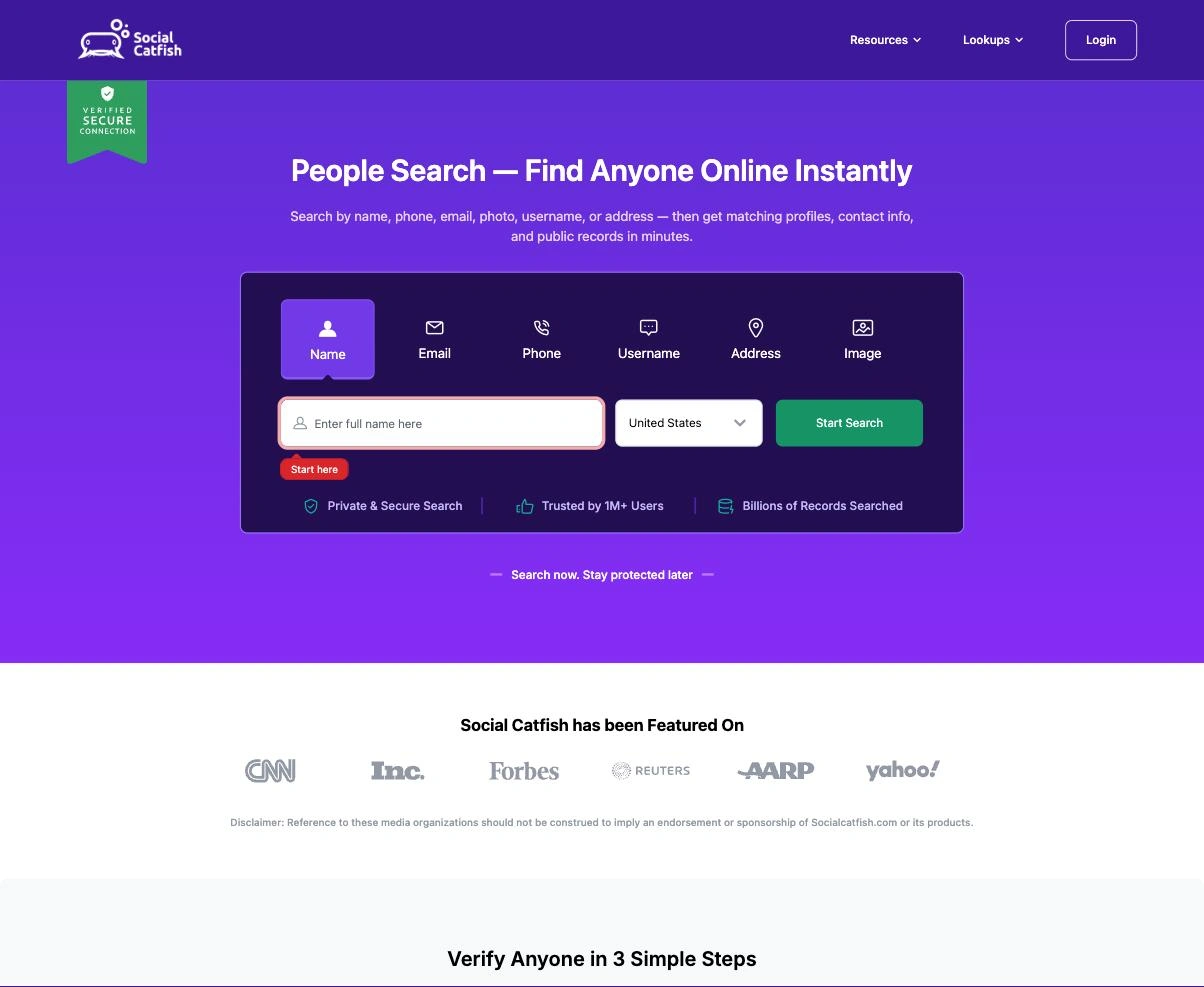
Social Catfish is the people-search site Google's AI answers mention most. It searches by name, email, username, phone number, address or photo, across "200+ trusted data sources" including social networks and public records. "You can start a search for free and preview potential matches," but full reports may need a paid plan, and its homepage doesn't list prices. It also states that it "is not a consumer credit reporting agency", so its results can't be used for credit, employment, insurance or tenant decisions. (Social Catfish, archived 14 September 2026)
Spokeo and BeenVerified sell similar searches. Spokeo's username search covers "120+ social sites" from $19.95 a month, and BeenVerified's starts at $36.89 a month. Both say they aren't consumer reporting agencies under the FCRA. (Spokeo, BeenVerified)
What users say about Social Catfish:
"Social Catfish / Scamfish has a way to at least verify an email’s authenticity"
"Social catfish has many great videos about those types of scams on YT)) Though I wouldn't recommend using their website (it got pretty pricy, there are cheaper alternatives out there)"
Google Lens and reverse image search
For a photo, start with Google Lens. Upload the image on Google, or right-click it in Chrome and choose "Search with Google Lens", and you'll see similar images and the pages that use them. (Google: search with an image)
The other tools people suggest have limits you should know about. TinEye finds exact and edited copies of an image, but it "cannot find different images featuring the same people", and it does "not typically add social media images" to its index. It's free for non-commercial use. (TinEye help) PimEyes searches by face across "10+ billion images", but it "does not search or index content from social media platforms", and free results come blurred, without sources. (PimEyes)
What users say about reverse image search:
"yandex/google together will do the job 99% of the time"
"Google amd Yandex reverse image searches are much better, tineye has aged horribly."
"Same deal for PimEyes, the free tier is pretty limited and a lot of dating app profile pics just don't show up in its crawl."
How to search all social media at once for free
No free tool searches every network's live data at once (we explain why below). This combination gets you closest:
- Start broad on Google with
"your keyword" (site:reddit.com OR site:x.com OR site:linkedin.com OR site:bsky.app), and addafter:2026-09-01if you only want recent results. - Run the same keyword on Social Searcher for a mixed feed without writing any operators.
- Go deeper on the networks that matter to you with their own search: Reddit's comment search, X Advanced Search, Bluesky with
since:, and LinkedIn's Posts tab. - If you're doing this more than once a week, save it in a monitoring tool instead.
Search operators by platform
| Where | Operators you can use | Example |
|---|---|---|
site:, "exact phrase", -exclude, OR, before:, after: | site:reddit.com "best crm" after:2026-01-01 | |
| X | Advanced search filters for words, accounts and dates (builder) | Built in the form, then run on X |
subreddit:, author:, title:, site:, url:, AND OR NOT (search tool) | subreddit:SaaS title:alternative | |
| Bluesky | from:, to:, mentions:, domain:, lang:, since:, until:, #tag | "your brand" since:2026-10-01 lang:en |
AND OR NOT in capitals, "exact phrase", brackets | "social listening" AND (startup OR SaaS) | |
| Hacker News | Quoted terms, plus date and type filters on hn.algolia.com | "your brand", comments, past week |
How to find someone's social media accounts
Work from the details you already have, and don't trust a match until at least two independent details line up, such as the profile photo and the location, or the employer and a linked website. A shared name or username on its own proves nothing.
With a name, search Google with the name in quotes plus something specific: "Jane Doe" "Chicago" marketing. Add site:linkedin.com/in to stay on LinkedIn.
With a username, run WhatsMyName or Sherlock. People reuse handles more than they think.
With an email address, try FootprintIQ or Epieos.
With a phone number, FootprintIQ works too, and so do paid people-search sites like Social Catfish.
With a photo, use Google Lens. If the picture was copied from a public profile, the original may show up.
Why no tool searches every network
Every "search all social media" tool hits the same wall: each network controls access to its own data, on its own terms.
X charges for API access per use, at $0.005 per post read, and caps pay-per-use plans at 3 million post reads a month. (X API pricing) Reddit's API is free at 100 queries a minute per client, but commercial use needs "a separate agreement with Reddit". (Reddit Data API wiki, Data API terms) LinkedIn asks visitors to sign in to keep searching. Bluesky is the exception, open to anyone.
That's why tools that run on Google's index, like Social Searcher, miss recent posts, and why image tools like TinEye and PimEyes leave social media out entirely. Free tools give up coverage to stay free, and paid tools pay for access to specific networks. Before you trust "no results", check which networks the tool actually covers.
Keep searching automatically: monitoring tools
If you run the same search more than once a week, a monitoring tool will save it and tell you when something new turns up.
SnitchFeed
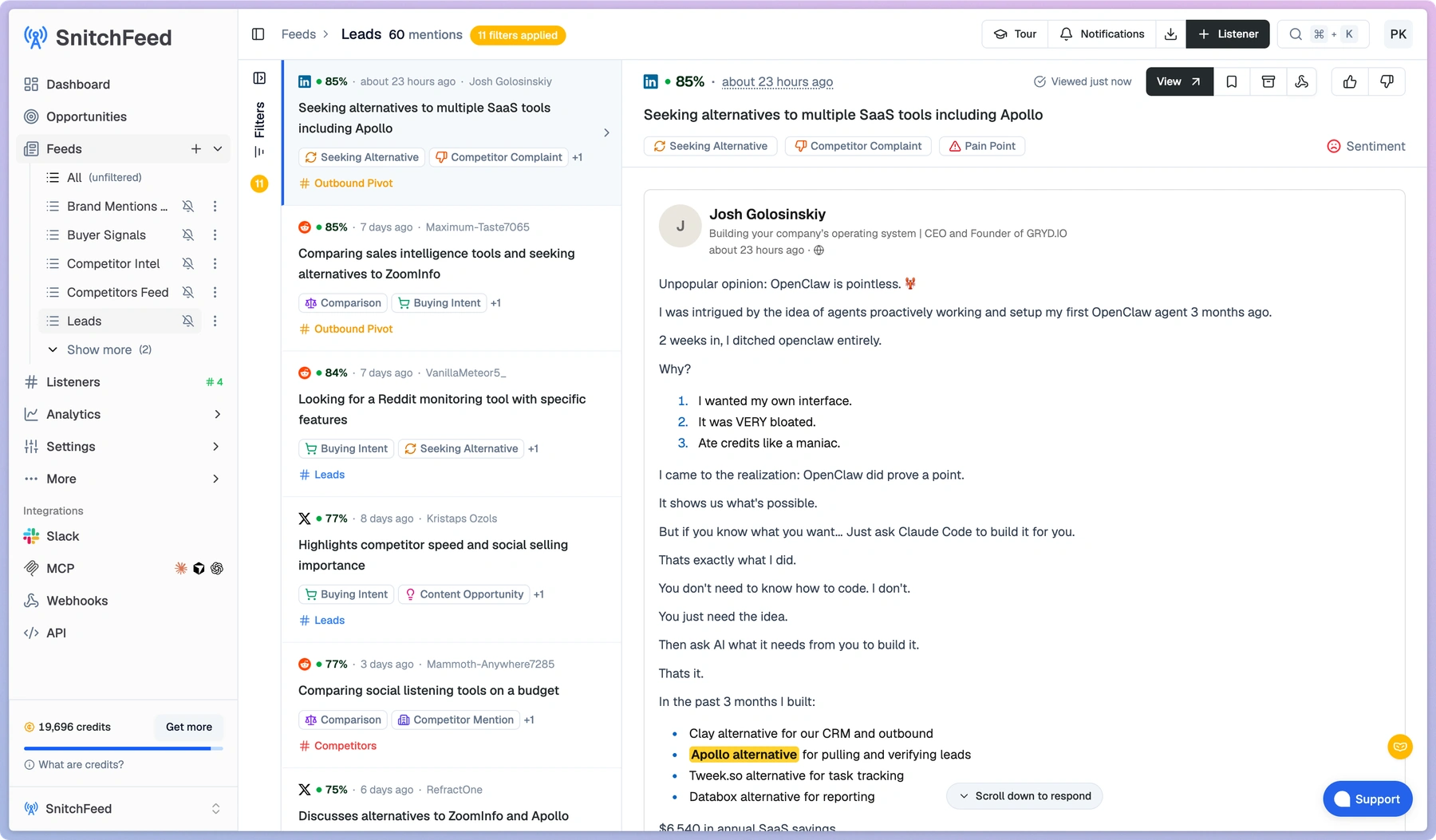
This is our product, built for B2B teams who need to catch new posts on Reddit, X, LinkedIn, Bluesky and Hacker News. You save a keyword query once. SnitchFeed checks Reddit and Bluesky in real time and X, LinkedIn and Hacker News as often as hourly, and when you first save a query it pulls in recent matches too (the last 14 days on Reddit). Each mention gets a relevance score and intent tags, and alerts go to email, Slack or Discord. You can also run one-off searches through its MCP server and API.
It doesn't cover Facebook, Instagram, TikTok or YouTube, and it isn't a people-search tool. Starter is $59 a month ($564 a year) and Pro is $119 a month ($1,140 a year). The 7-day trial doesn't need a card.
Website: snitchfeed.com
Hootsuite
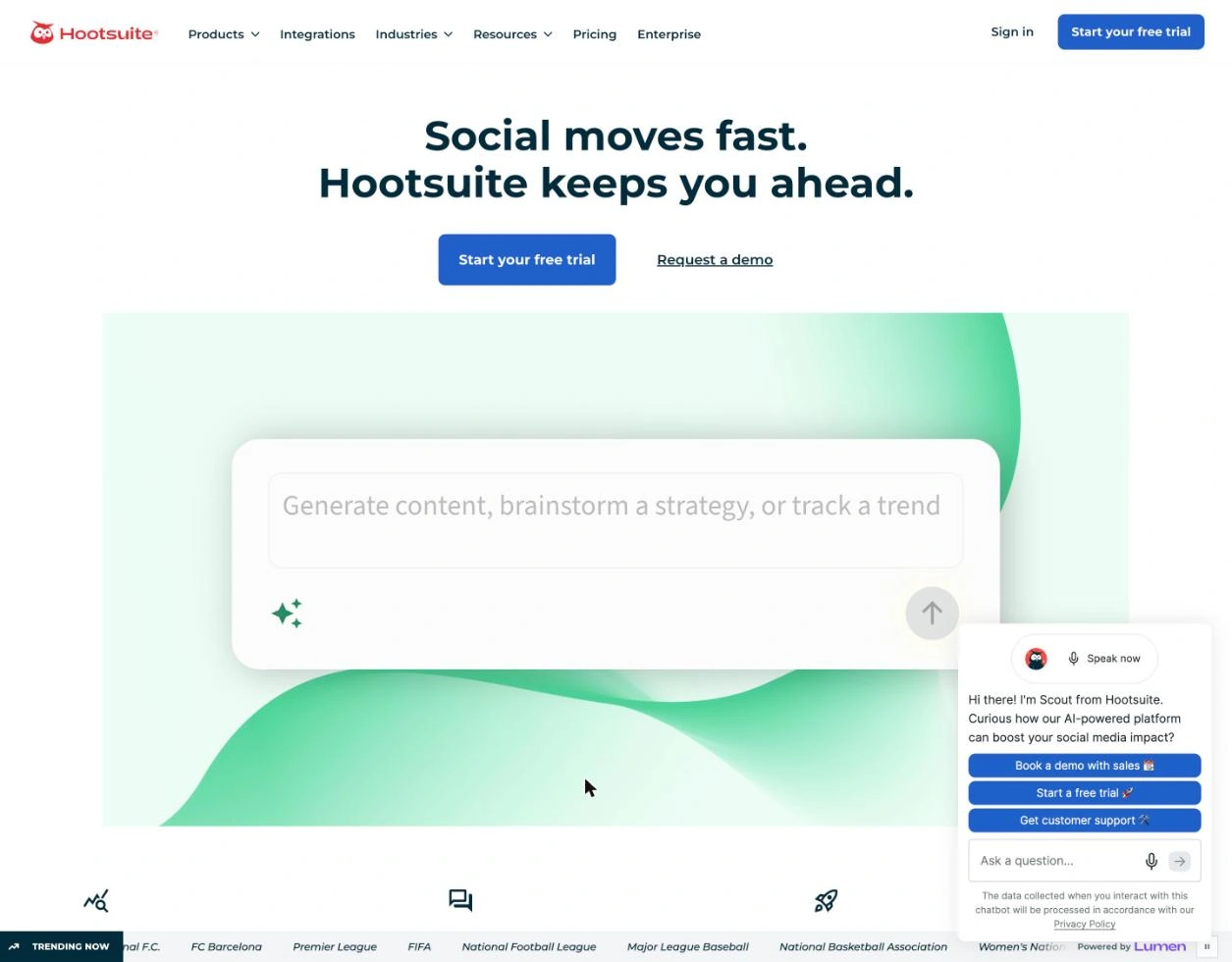
Hootsuite makes sense if you already schedule posts there. Its Quick Search shows "trends and mentions from the past 7 days" on the Standard plan ($99 per user a month, billed annually), and 30 days from Professional up. Search streams keep a query running in your dashboard. Check the sources before you buy, though: Standard covers news, blogs, forums, Facebook, X, Bluesky, YouTube, Quora and podcasts, while Reddit, LinkedIn, Instagram and Threads are "Advanced data sources" on Enterprise only. The trial is 14 days, no card. (Hootsuite plans)
Website: hootsuite.com
What users say about Hootsuite search streams:
"it's already a superior way to use twitter. Tweets displayed according to time instead of based on algorithm (what a concept), customizable hashtag streams etc."
"its been 3 days now since facebook streams are not working, and the message we have now is "Facebook has restricted third-party access to search functionality. As a result, Hootsuite is no longer able to offer this stream type"."
Brand24
Brand24 has the broadest coverage here, including Instagram and TikTok on higher plans. There's no search box, though. You create a project, it starts with a sample of mentions from the last 30 days, and then it keeps collecting. Individual is $249 a month, or $199 a month billed annually, and the 14-day trial needs no card. (Brand24 historical data, pricing) We compare it with its rivals in Brand24 alternatives.
Mention
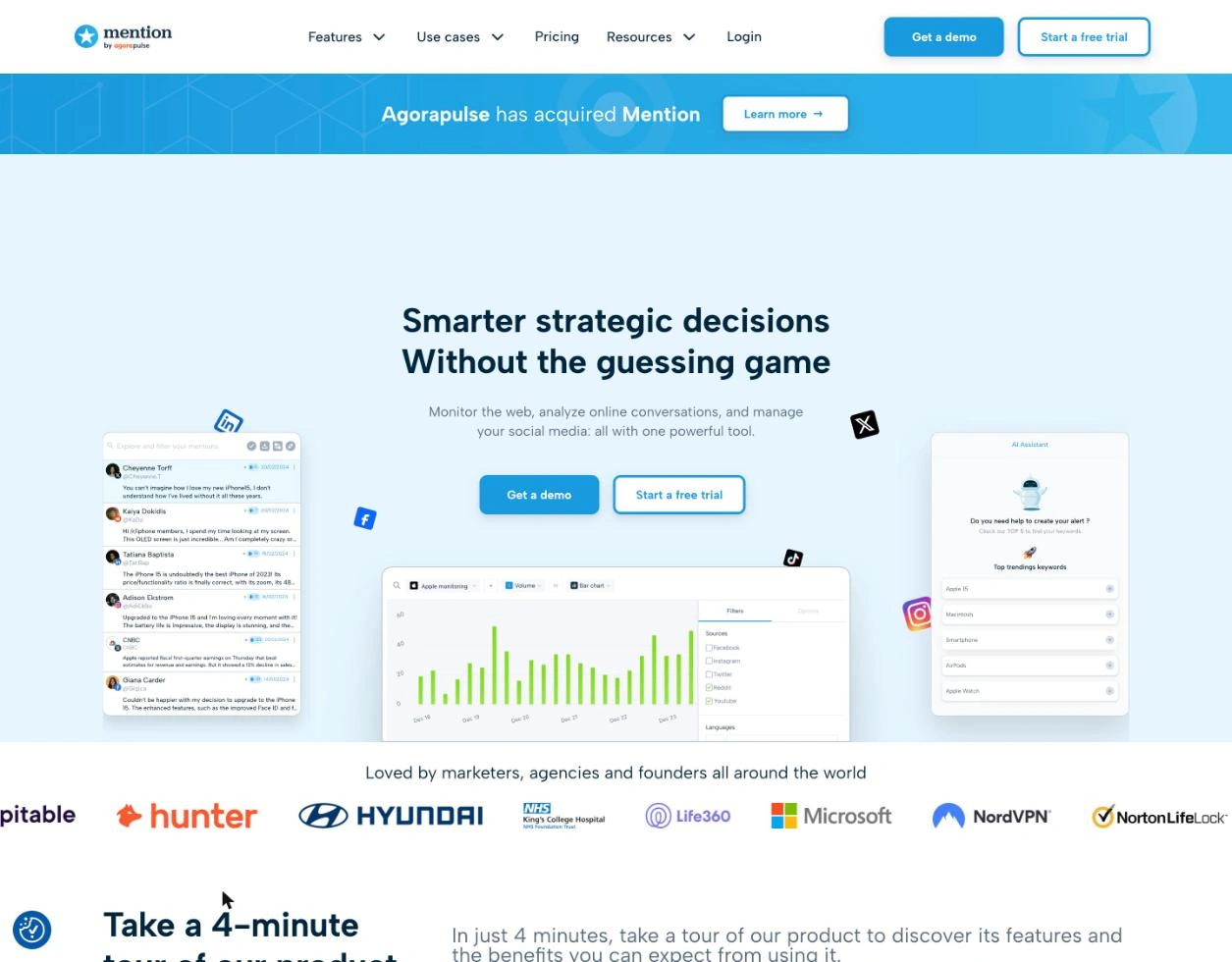
Mention, now part of Agorapulse, also covers review sites. It works through alerts rather than one-off searches, and historical data is "a paid add-on". There are no published prices; the pricing page asks you to book a demo. The 30-day trial runs through Agorapulse and needs no card. (Mention pricing)
If you'd rather not pay, see free social listening tools. For the wider paid field, see the best social listening tools.
Tools that no longer work
Older lists still recommend these.
- KnowEm: the domain no longer resolves, and the last working snapshot is from April 2024.
- Social Mention: socialmention.com no longer loads.
- Pipl: now sold only to businesses (fraud, compliance and investigation teams) through demos.
- TweetDeck: became X Pro, which needs X Premium+.
- Boardreader: the forum search engine still loads, but its pages are set not to be indexed, and we couldn't get it to return results.
- Google+: shut down for consumers in 2019, though some library guides still list it.
Privacy and legal limits
These tools only find what people have made public. Private accounts stay private, and nothing here can (or should) get past a login.
A matching username or name isn't proof of identity. Before you act on a match, confirm it with at least two independent details.
People-search sites such as Social Catfish, Spokeo and BeenVerified say they are not consumer reporting agencies. Under the US Fair Credit Reporting Act, that means their results can't be used to decide on credit, jobs, insurance or housing.
Using these tools to track or contact someone who doesn't want to hear from you can break platform rules and the law.
They're also useful on yourself. Run your own username, email and photo through them to see what a stranger could find.
FAQ
What is the best social media search engine?
It depends on what you're looking for. For posts and mentions, Social Searcher is the best free tool and Google's site: operators are the most flexible. For a person, WhatsMyName and Sherlock are the best free username searches, and FootprintIQ covers email and phone numbers. For searches you repeat, a monitoring tool such as SnitchFeed, Hootsuite or Brand24 saves time.
Can you search all social media at once?
Not completely. No free tool searches every network's live data at once, because X, Reddit and LinkedIn each control access to their data. The closest free method is Google with several site: operators, such as "keyword" (site:reddit.com OR site:x.com OR site:bsky.app), combined with Social Searcher. Paid monitoring tools cover more networks in one place.
Is there a free social media search engine?
Yes. Social Searcher is free and unlimited with no sign-up, Talkwalker's Free Social Search covers the last 7 days for free, and every network's own search costs nothing. For people search, WhatsMyName, Sherlock and Recosint are free, and so is FootprintIQ's basic scan.
How do I check if a person is on social media?
Search their name in quotes on Google with something specific, such as their city or employer, then run their username through WhatsMyName or Sherlock. If you have their email address, FootprintIQ or Epieos can check for linked accounts. Before you trust a match, confirm it with two independent details, such as the profile photo and location.
How can I find someone's social media accounts using just their picture?
Run the photo through Google Lens. If the image was posted publicly, Google may show the pages that use it, including profile pages. TinEye finds exact copies but not other photos of the same person, and PimEyes searches by face but leaves out social media sites.
Can you find someone on social media with their email address?
Sometimes. FootprintIQ and Epieos check which public accounts are linked to an email address, and paid people-search sites such as Social Catfish accept emails too. Many networks hide email addresses, so finding nothing doesn't mean the person has no accounts.
Can you look someone up on social media by their phone number?
Partly. FootprintIQ, Epieos and paid sites like Social Catfish accept phone numbers, but you'll only get results if the person linked that number publicly. Most networks keep phone numbers private.
How do I find all accounts with a username?
Search the username on WhatsMyName, which checks 700+ websites in your browser, or run Sherlock, which checks 400+ sites from the command line. Both are free. A match means an account with that name exists, not that it belongs to the person you're looking for. When we ran Sherlock on our own name, one of its 8 hits was a false positive.
How can I find out if someone has a secret social media account?
You can only find accounts that are public and linked to something you know, such as a username, email address, phone number or photo. The methods above are the same ones you'd use, and a match still isn't proof of who runs an account. Private accounts can't be searched, and tracking someone without their consent can break platform rules and the law.
Is Social Searcher legit?
Yes. Social Searcher is a real, free social media search engine with no sign-up and no paid plans. It finds public results using Google's search technology rather than collecting data from the platforms, so it's safe to use, but only as complete as Google's index.
What is the difference between social listening and social media search?
Social media search is a one-off: you search and see what's there now. Social listening saves the search and keeps running it, so you find out about new posts, usually with sentiment, relevance scoring and reports. Search answers a question once. Listening catches every new mention.
Related articles
Free Social Listening Tools in 2026: 9 Tested, Real Limits
Talkwalker Alerts, F5Bot, Google Alerts, KWatch and 5 more free social listening tools, tested, with each free tier's real limits and platforms.
21 min readBest Social Listening Tools in 2026: Pricing and Reviews
Pricing, features, and real reviews from Reddit, X, and LinkedIn for 21 social listening tools, grouped by team type, from enterprise to free.
32 min readHow to Search Twitter (X) Without an Account: 5 Methods That Work in 2026
Five reliable ways to search public X (Twitter) posts without an account or login, what each method can and can't do, and how to search X programmatically when you need results at scale.
7 min read


