Best Competitor Monitoring Tools for Startups in 2026 (12 Compared)
Parth Koshti


Founder @ SnitchFeed
The best competitor monitoring tools for startups in 2026 are SnitchFeed (from $59/mo, tags competitor mentions, competitor complaints, and seeking-alternative signals across Reddit, X, LinkedIn, and Bluesky), Visualping (from $10/mo, AI-summarized website and pricing-page change alerts), and Competitors App ($9.90 per competitor/mo, tracks emails, social, SEO, and reviews). Beyond those three, a wider set of specialized tools covers email campaigns (Owletter), paid search and SEO (SpyFu), tech-stack changes (Wappalyzer), and company news (Owler), while enterprise suites like Klue, Crayon, Contify, and Brandwatch start around $15,000 to $150,000+ a year and assume a dedicated analyst running the program. This guide compares 12 tools across every major competitive signal, with the feature depth, pricing tiers, API/AI agent support, and honest limitations behind each one.
Why most "competitive intelligence" software doesn't fit startups
Search "competitive intelligence tools" and the top results are Klue, Crayon, Contify, and Brandwatch: enterprise platforms built for dedicated competitive-intelligence, product-marketing, or consumer-research teams. They're strong products, with G2 ratings around 4.6-4.8/5 across hundreds of reviews, but three things make them a poor fit for a startup:
- Sales-led, quote-only pricing. None of Klue, Crayon, Contify, or Brandwatch publish a rate card. Third-party procurement data puts entry deployments around $15,000 to $30,000/year, scaling to $50,000-$150,000+ for larger teams, all negotiated through a demo call, not a signup page.
- A dedicated owner is assumed. These platforms expect a product marketer, CI analyst, or research team spending real weekly hours authoring battlecards, tuning taxonomies, and filtering noise. Without that role, reviewers describe the software becoming "expensive shelfware."
- Weeks of setup, and noise once it's live. Buyer guides for this category cite 4-8 week implementation windows before the platform is generating value, and G2 reviewers across these vendors repeatedly cite alert noise ("too much noise, not enough signal") as an ongoing tax even after go-live.
What most startups actually need is smaller in scope: know when a competitor comes up in a Reddit thread, changes their pricing page, sends a new email campaign, or ships a feature that shows up in their tech stack. That's a narrower, cheaper problem than enterprise CI software solves, and it's what most of the tools below are built for.
Quick comparison: 12 competitor monitoring tools
| Tool | Best for | Starting price | Setup time | Self-serve | API | AI agent ready (MCP) |
|---|---|---|---|---|---|---|
| SnitchFeed | Competitor mentions & sentiment on social | $59/mo | Minutes | ✅ | ✅ | ✅ Official, all plans |
| Visualping | Competitor website & pricing-page changes | Free / $10/mo | Minutes | ✅ | ✅ | ❌ |
| Competitors App | All-in-one marketing-channel competitor tracking | $9.90/competitor/mo | Minutes | ✅ | ❌ | ❌ |
| Owletter | Competitor email campaign tracking | $29/mo | Minutes | ✅ | ❌ | ❌ |
| SpyFu | Competitor PPC & SEO keyword research | $39/mo | Minutes | ✅ | ✅ | ❌ |
| Wappalyzer | Competitor tech-stack change alerts | Free / $250/mo | Minutes | ✅ | ✅ | ✅ Official |
| Owler | Free/cheap competitor company news alerts | Free / ~$35/mo | Minutes | ✅ | ⚠ Max tier only | ❌ |
| Kompyte | Budget-friendly automated battlecards | $300/yr | ~1-2 weeks | ⚠ Limited | ✅ | ❌ |
| Klue | Sales battlecards & win-loss at enterprise scale | ~$20K-$60K/yr (quote) | Weeks | ❌ | ✅ | ⚠ Agentic AI, not MCP |
| Crayon | Broad enterprise CI programs | ~$15K-$50K+/yr (quote) | Weeks | ❌ | ✅ | ❌ |
| Contify | Enterprise market & competitive intelligence | ~$25K-$80K/yr (quote) | Weeks-months | ❌ | ✅ | ❌ |
| Brandwatch | Enterprise social listening & consumer research | ~$20K-$150K+/yr (quote) | Weeks | ❌ | ✅ | ❌ |
SnitchFeed
SnitchFeed watches Reddit, X/Twitter, LinkedIn, and Bluesky for your competitors' names and tags every mention by intent: competitor mention (neutral reference), competitor complaint (someone frustrated with them), and seeking alternative (someone actively looking to switch), plus sentiment tagging (positive, negative, neutral) on top. That's the specific signal a startup wants: not "did our competitor get mentioned" but "is someone unhappy enough with them to switch," which is the mention worth acting on today.
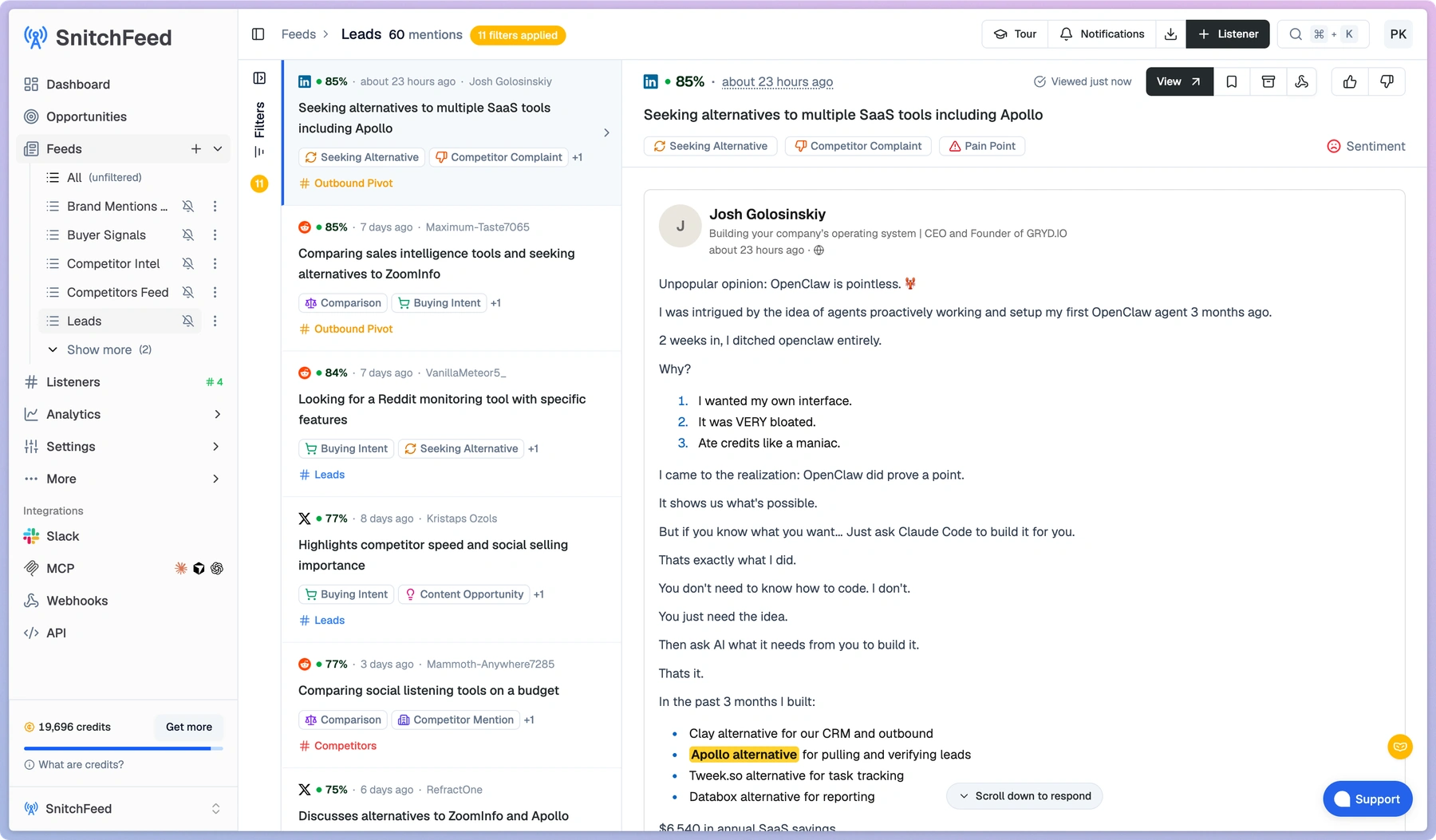
Features:
- Intent tagging built specifically to separate neutral competitor chatter from switching-intent and complaint signals
- Same feed covers your own brand mentions and your competitors', so you can compare sentiment side by side
- Real-time alerts to Slack, Discord, email, or webhook the moment a switching-intent post appears
- Fit Score and AI-drafted reply suggestions on individual mentions, not just a raw alert feed
API / AI agents: REST API plus an official MCP server (24 tools) on every plan.
Pricing: Starter $59/mo ($47/mo annual). Pro $119/mo ($95/mo annual). 7-day free trial, no credit card.
Honest limitations: No website or pricing-page change tracking, no battlecard generation, no sales-enablement workflow. SnitchFeed tells you what people are saying about your competitors on social platforms, not what your competitors are doing on their own website.
Best for: Startups and GTM teams that want to catch switching-intent and competitor-complaint signals on social platforms without a CI budget or a dedicated analyst.
Visualping
Visualping monitors a competitor's website (pricing pages, changelogs, job listings) and sends an AI-summarized alert the moment something changes, with a screenshot of exactly what moved.
Features:
- Visual, text, and element-specific monitoring, so you can watch a whole page, just the copy, or a single HTML element
- AI-powered noise reduction: trainable to ignore "meaningless" changes like moving banners or date stamps and alert only on changes it scores as important
- Check frequency configurable per monitor, from as fast as every 2 minutes (higher paid tiers) down to daily, weekly, or monthly
- API access, webhooks, and Zapier included on every plan, including Free; Business plans add native Slack, Microsoft Teams, and Google Sheets integrations
API / AI agents: API and webhooks on every plan, including free. No MCP server.
Pricing: Free (5 pages, 150 checks/month, hourly checks). Personal from $10/mo (10 pages, 1,000 checks). Business from $100/mo (200 pages, 20,000 checks, team integrations). Solutions (enterprise) from $3,000/year.
Honest limitations: Visual diffing can throw false positives when a competitor reworks page layout or CSS rather than content, and reviewers note cost scales quickly once you need high-frequency checks across many pages. It only watches specific URLs you add, with no competitor-name or social-mention tracking at all. Native team integrations (Slack, Teams) are gated to the $100/mo Business plan; entry tiers are effectively single-user.
Best for: Catching the moment a competitor changes pricing, ships a feature, or updates a job page, a different signal than social mentions and a genuine gap SnitchFeed doesn't cover.
Competitors App
Competitors App tracks a wider marketing surface per competitor than most tools at its price: website changes, trial email sequences, social posts, SEO keyword rankings, ad activity, and reviews, delivered as a daily or weekly digest.
Features:
- Tracks website changes, trial/onboarding email sequences, blog and social posts, SEO keyword rankings, ad activity, and reviews from 100+ review sites, per competitor
- AI-generated review summaries that surface positioning, pain points, and strengths without reading every review manually
- Timeline view filterable by competitor and feature type, plus a daily/weekly digest email so no one has to check a dashboard
API / AI agents: No public API, webhooks, or named integrations beyond a handful of basics (Slack, Zapier) based on third-party review coverage. No MCP server.
Pricing: Flexible $9.90/competitor/month. Agency $14.90/competitor/month (white-labeling, multi-user). Standard $19.90/competitor/month. Pay only for competitors you actively track.
Honest limitations: Per-competitor pricing scales linearly, reviewers report costs climbing to $148-$298/month once you're tracking 15+ competitors, often past what broader enterprise tools would cost. No API or webhooks means distributing findings to Slack, a CRM, or a sales-enablement tool is a manual copy-paste job. The UI is frequently described in reviews as dated, and review volume on G2/Capterra is thin (a few dozen reviews) compared to Klue or Crayon.
Best for: Marketing teams that want one weekly digest covering everything a competitor is doing across email, ads, SEO, and reviews, not just social mentions or website changes alone.
Owletter
Owletter automatically captures, screenshots, and archives every marketing email a tracked competitor sends to their list, so you can study their offers, cadence, and seasonal patterns without subscribing to a dozen newsletters yourself.
Features:
- Captures and screenshots every email a monitored domain sends, stored forever on Pro and Unlimited plans
- Keyword-based instant alerts (for example "sale" or "launch") plus monthly or unlimited summary roundups
- Team-wide access to the full email archive, filterable by competitor and date
API / AI agents: No public API or MCP server found; delivery is via dashboard, email roundups, and keyword alerts only.
Pricing: Starter $29/mo (10 websites, 1 alert/month, 12-month retention). Pro $49/mo (25 websites, unlimited alerts, lifetime retention). Unlimited $99/mo (unlimited websites). 14-day free trial on every plan.
Honest limitations: No AI content scoring, sentiment analysis, or subject-line testing, it captures and stores emails but leaves the analysis to you. No API means you can't pull competitor email data into your own tools or dashboards. Covers one channel only (email); pair it with a social or website-change tool for the full picture.
Best for: Retailers, agencies, and marketers who want an automatic archive of every competitor email campaign, without babysitting a dozen throwaway inboxes.
SpyFu
SpyFu reverse-engineers a competitor's Google Ads and organic SEO strategy, showing every keyword they've bid on since 2006, which ad variations they kept versus dropped, and their estimated monthly spend.
Features:
- 19+ years of historical Google Ads data per domain: keywords bid on, ad copy tested, and estimated spend
- Organic keyword rankings, backlink overview, and ranking history (lighter than dedicated SEO suites)
- Unlimited searches and data exports on every paid plan, plus white-label reporting for agencies
API / AI agents: API access and ChatGPT integration on the Pro + AI plan. No MCP server.
Pricing: Basic $39/mo ($29/mo annual). Pro + AI $119/mo ($89/mo annual, 10+ years historical data). Team/Agency $249/mo ($187/mo annual, 5 users). No permanent free tier; 30-day money-back guarantee.
Honest limitations: No technical site auditing and no social-ad coverage, it's Google Ads and organic SEO only. Backlink data is noticeably lighter than Ahrefs or Semrush. Coverage is concentrated in 18 countries, thinner outside the US and UK.
Best for: Marketers who want to see exactly which paid keywords and ad copy a competitor is running (and has run for years), not their social or website activity.
Wappalyzer
Wappalyzer fingerprints the technology stack behind any competitor's website (CMS, analytics, ecommerce platform, tag managers) from page scripts and network requests, and can alert you the moment a tracked domain adds or drops a technology.
Features:
- Detects roughly 3,000 technologies via browser extension or API, with same-day alerts when a tracked site's stack changes
- Bulk lookups (up to 100,000 URLs per CSV) for scanning a whole competitor or prospect list at once
- CRM integrations (Salesforce, HubSpot, Pipedrive) that auto-populate tech-stack fields on inbound leads
API / AI agents: REST API plus an official MCP server, so AI agents can query a domain's tech stack directly. No native Slack or webhook alerting beyond the trigger API.
Pricing: Free browser extension for one-off lookups. Pro from $250/mo, Business from $450/mo (webhooks, CRM integrations), Enterprise from $850/mo (multi-user, higher result caps).
Honest limitations: Client-side detection only, it sees front-end technologies (analytics, CMS, JS frameworks) but misses back-end infrastructure and server-side tools. Its roughly 3,000-technology catalog is far narrower than BuiltWith's 700,000+, so niche or in-house tools often return no match. No historical adoption data on any tier.
Best for: Product and growth teams that want to know what a competitor's site runs on (and get pinged when it changes) rather than what people are saying about them.
Owler
Owler is a crowdsourced business-intelligence feed: follow a competitor and get real-time alerts on funding rounds, leadership changes, acquisitions, and other company news, plus a "competitive graph" mapping 45M+ company relationships.
Features:
- Real-time alerts across 25+ news event categories (funding, M&A, leadership changes) sourced from 5M+ community contributors
- Competitive Graph and Daily Snapshot newsletter summarizing what tracked competitors did that day
- Owler AI Chrome extension for drafting outreach based on a company's news feed (Max tier)
API / AI agents: Limited API access on the Max tier, plus Salesforce, HubSpot, and Slack integrations. No MCP server; Owler AI is a built-in writing assistant, not an agent-callable protocol.
Pricing: Community (free): follow 5 companies, 1 profile view/month. Pro ~$35-39/mo billed annually (unlimited follows, revenue estimates, advanced alerts). Max from ~$350/mo (contact data, CRM sync, sales triggers). Enterprise custom.
Honest limitations: Revenue and employee data are crowdsourced and can be inaccurate for private companies, treat it as a news feed, not a source-of-truth database. The free tier is genuinely thin (one profile view a month), most reviewers say they upgrade within a week. No native translation, so non-English sources are machine-translated with mixed accuracy.
Best for: Sales and marketing teams that want a free or cheap way to get pinged on competitor company news (funding, leadership, M&A) without a dedicated CI budget.
Kompyte
Kompyte, acquired by Semrush in 2022, automates competitor monitoring across websites, pricing pages, social media, job postings, and reviews, then drafts battlecards and content from what it finds, at a fraction of Klue or Crayon's price.
Features:
- Automated tracking of competitor websites, pricing, social, job postings, and reviews with AI-summarized digest updates
- Unlimited battlecards and reports, with no extra charge for adding or swapping tracked competitors
- Kompyte GPT for AI-assisted competitive analysis, plus Salesforce, HubSpot, and Slack integrations
API / AI agents: Bi-directional CRM integration (Salesforce, HubSpot). No conversational AI interface and no MCP server, Kompyte GPT is an internal generative-AI layer, not an agent-callable protocol.
Pricing: Essentials from $300/year, the cheapest dedicated CI platform in this list by a wide margin. Professional and Unlimited tiers scale up from there (custom quotes); Semrush subscribers may get additional discounts.
Honest limitations: Data collection and battlecard depth are noticeably lighter than Crayon or Klue, battlecards still need manual editing rather than one-click generation. No automatic translation of non-English sources, a blind spot for global competitors. Adding new tracked companies or sources isn't fully self-service and can come with extra cost.
Best for: SMBs and startups that want real (if lighter-weight) competitive intelligence and battlecards without a $20K+/year Klue or Crayon contract.
Klue
Klue pairs competitive battlecards with "Compete Agent," an agentic AI layer that surfaces deal-specific coaching to sales reps, and holds the highest G2 rating in the category (4.7/5 across 440+ reviews), including "best usability" and "best battlecards" badges.
Features:
- Deepest sales-enablement integration in this category: battlecards live inside the CRM, with deal-specific coaching surfaced to reps mid-deal
- Compete Agent, an agentic AI layer built on top of tracked competitive intel
- Win-loss analysis and documented win-rate lifts at enterprise customers
- Centralized "single source of truth" workflow for intel gathered across the org
API / AI agents: Developer API. Compete Agent is agentic AI built into the product, not an MCP server third-party AI agents can call.
Pricing: No published rate card. Third-party procurement data puts entry deployments around $20,000-$25,000/year, scaling to $40,000-$60,000+ for enterprise tiers. Demo only, no self-serve trial.
Honest limitations: G2 reviewers consistently cite alert noise, one reviewer described the AI filtering as producing "far too many useless alerts" even after multiple consultations with Klue's team. Real learning curve and setup effort: Klue is explicitly built for enterprise deployments with ongoing content maintenance, not something a two-person team stands up in an afternoon. No published pricing, self-serve signup, or usage-based entry tier; everything routes through a sales demo.
Best for: Sales-led enterprises with a dedicated competitive enablement or product marketing role to run the program.
Crayon
Crayon is a broader enterprise CI platform than Klue's sales-battlecard focus, tracking competitor websites, job postings, SEC filings, and market signals across 100+ data types and 7M+ sources for bigger competitive-intelligence programs.
Features:
- Monitors 100+ data types (websites, job boards, review sites, SEC filings, social) across millions of sources
- Dynamic battlecards with Salesforce and HubSpot integrations
- Built-in G2 Reviews data (1.6M+ validated customer reviews) searchable directly in the platform
- Category tenure since 2014, with hundreds of G2 reviews and a large enterprise customer base (Dropbox, Gong, Intuit, ZoomInfo, Zendesk)
API / AI agents: Developer API on higher tiers. No MCP server found.
Pricing: No published rate card. Third-party data puts entry deployments around $15,000-$16,000/year, with enterprise programs commonly cited in the $30,000-$50,000+ range and some deployments exceeding $100,000/year.
Honest limitations: The most repeated G2 complaint is signal-to-noise: monitoring millions of sources surfaces a lot of minor changes (CSS tweaks, reposted job listings, duplicate news) that need manual curation to find what's actually actionable. Crayon tells you what changed, reviewers note it generally doesn't tell you what it means strategically or what to do about it. Implementation takes weeks, and multiple reviews describe the platform becoming "expensive shelfware" without a dedicated CI owner actively curating it.
Best for: Enterprise teams running a formal, cross-functional CI program that needs more than sales battlecards.
Contify
Contify positions itself as broad market and competitive intelligence rather than sales-battlecard software, pulling from a large sourced dataset (reported at 1M+ sources across 117 languages, tracking 700,000+ companies) with its Athena AI layer summarizing what changed. Gartner named it a "Visionary" in the inaugural 2026 Magic Quadrant for Competitive and Market Intelligence Platforms.
Features:
- 1M+ curated sources with auto-translation across 117+ languages, tracking 700,000+ companies and 100+ industry segments
- Athena AI engine generating structured fact cards, exportable tables, and AI-summarized briefs without manual prompting
- Entity-centric taxonomy built for tracking named competitors plus broader market/industry trends (M&A signals, regulatory filings)
API / AI agents: API available on enterprise plans. No MCP server; Athena is an internal AI layer, not an agent-callable protocol.
Pricing: No published rate card. Third-party data puts typical deployments at $25,000-$60,000/year, with some sources citing a wider $7,000-$84,000 range depending on scope.
Honest limitations: Not plug-and-play: onboarding requires analyst-assisted taxonomy and source configuration that reviewers describe taking one to several weeks (some vendor case studies cite 3-5 days of analyst sessions just for initial setup) before output is reliable. Reviewers flag duplicate stories surfacing from multiple sources and API restrictions that limit automatic tracking on some social platforms. Pricing is entirely quote-based with no public rate card or self-serve tier, and the platform is built for market-wide intelligence rather than tactical sales battlecards.
Best for: Enterprises that need market-wide intelligence (industry trends, M&A signals) alongside named-competitor tracking, with budget and a dedicated intelligence function to match.
Brandwatch
Brandwatch is an enterprise consumer-intelligence and social listening platform: track competitor brand conversations at massive scale (multi-year historical archives) with AI-assisted (Iris AI) sentiment, image recognition, and executive-ready reporting.
Features:
- Enterprise-scale historical social data (multi-year archives) with sentiment analysis and image recognition on higher tiers
- Iris AI-enhanced analysis of consumer conversation, built for crisis monitoring and stakeholder reporting
- Deep query-building tools for complex, multi-market listening programs across 83+ languages
API / AI agents: API access on the Enterprise tier. No MCP server; Iris AI is an internal analysis layer, not an agent-callable protocol, and it cannot track brand mentions inside AI chatbot responses (ChatGPT, Perplexity).
Pricing: No published rate card; Brandwatch discontinued its lower-cost Essentials tier and moved to enterprise-only positioning. Third-party procurement data puts a median annual contract around $50,000, ranging from roughly $20,000 to $150,000+ depending on scope, users, and historical data depth.
Honest limitations: No self-serve signup or transparent pricing, everything is a custom enterprise quote with annual contracts. Steep learning curve for complex query building; onboarding and implementation fees can run 10-15% of contract value on top for complex deployments. Platform coverage is constrained by Meta and TikTok API restrictions, and it can't see private groups, dark social, or native TikTok/Reels video content the way it parses text.
Best for: Large enterprises that need deep, multi-year consumer research and crisis-monitoring social listening across markets, with a budget well beyond what SnitchFeed, Visualping, or Competitors App are built for.
How to choose
Match the tool to the signal, not the category. "Competitor monitoring" isn't one signal, it's at least six: social mentions (SnitchFeed), website and pricing changes (Visualping), email campaigns (Owletter), paid search and SEO (SpyFu), tech stack (Wappalyzer), and company news (Owler). No single tool here covers all six. Pick based on where your competitive risk actually shows up, or stack two or three narrow tools (often still cheaper than one enterprise suite).
Budget and dedicated headcount. If you don't have a product marketer or analyst whose job includes running a CI program, Klue, Crayon, Contify, and Brandwatch will mostly go unused regardless of price, reviewers describe exactly this pattern once a dedicated owner isn't actively curating the feed. SnitchFeed, Visualping, Competitors App, Owletter, SpyFu, Wappalyzer, and Owler are all built to run with zero dedicated headcount. Kompyte sits in between: real CI and battlecards at SMB pricing, but not fully self-service.
How much noise you can tolerate. Enterprise CI and listening platforms monitor far more sources than startup tools, which means more raw data but also more manual filtering. If "tells you what changed" without "tells you what it means" isn't useful to your team, a narrower, higher-signal tool (SnitchFeed's intent tagging, Visualping's importance flags, Wappalyzer's trigger alerts) will save more time than a broader firehose.
Already running social listening? If you're using Brand24 or Octolens for your own brand mentions, check whether competitor-name tracking is already included in your plan before adding a separate tool; several social listening platforms (see Best Social Listening Tools in 2026 and Best Brand Monitoring Tools in 2026) support tracking any keyword, including a competitor's name, without intent tagging specific to competitive signals.
FAQ
What is the best competitive intelligence tool for startups?
For social-platform competitor signals (mentions, complaints, switching intent on Reddit, X, and LinkedIn), SnitchFeed starts at $59/mo with no dedicated analyst required. For website and pricing-page change tracking, Visualping has a genuine free tier. For narrower signals, Owletter (email), SpyFu (PPC/SEO), Wappalyzer (tech stack), and Owler (company news) each start under $50/month. Enterprise suites like Klue, Crayon, Contify, and Brandwatch are built for larger teams with a dedicated competitive-intelligence role and a $15,000+/year budget.
How much does competitive intelligence software cost?
Startup-accessible tools range from free (Visualping's and Owler's entry tiers, Wappalyzer's browser extension) to about $60/month (SnitchFeed's Starter plan) or a few dollars per competitor per month (Competitors App). Kompyte, a lighter-weight dedicated CI platform, starts at $300/year. Enterprise platforms like Klue, Crayon, Contify, and Brandwatch don't publish pricing; third-party procurement data puts typical annual contracts between $15,000 and $150,000+, before accounting for the internal headcount needed to run the program.
What's the difference between competitor monitoring and competitive intelligence?
"Competitor monitoring" usually refers to tracking a specific signal, like social mentions, website changes, or email campaigns, in something close to real time. "Competitive intelligence" is the broader enterprise discipline: synthesizing monitoring data, market research, and win-loss analysis into battlecards and strategic recommendations, typically run by a dedicated analyst or product marketer. Startups usually need the former; enterprise CI software is built for the latter.
Can I monitor competitors without buying enterprise software?
Yes. Website change trackers like Visualping and company-news feeds like Owler have genuine free tiers, per-competitor tools like Competitors App start under $10/competitor/month, and social listening tools like SnitchFeed track competitor names alongside your own brand for a flat monthly price, none of which require a demo call or a dedicated CI analyst.
What are the most common complaints about enterprise CI platforms like Klue, Crayon, Contify, and Brandwatch?
Across G2 and other review platforms, the most repeated complaints are alert noise (too many low-value alerts requiring manual filtering), a real setup and learning curve (weeks of implementation, ongoing content maintenance), and pricing opacity (no public rate card, everything routes through a sales demo). All four also assume a dedicated CI or research owner; reviewers note the platforms become underused "shelfware" without one.
Do any competitor monitoring tools support AI agents (MCP)?
SnitchFeed and Wappalyzer both ship official MCP servers, so Claude, Cursor, or ChatGPT can query competitor mentions, sentiment, or tech-stack data directly. Klue's Compete Agent and Kompyte GPT are agentic AI built into their own products, not MCP servers third-party agents can connect to. None of Crayon, Contify, Brandwatch, Visualping, Competitors App, Owletter, SpyFu, or Owler currently ship MCP support.
Related articles
Social Media Search Engines in 2026: Find Posts and People
Find posts on Reddit, X and Bluesky, or a person's profiles by username, email or photo: Social Searcher, WhatsMyName, Sherlock and 15 more, compared.
20 min readBest Reddit Monitoring Tools in 2026: 12 Free and Paid, Tested
12 Reddit monitoring tools compared on alert speed, price, and AI filtering, from free keyword alerts to real-time tools that find buyers.
27 min readBest Brand Monitoring Tools in 2026 (Compared)
The 12 best brand monitoring tools in 2026 for tracking your brand's health and reputation over time, compared on pricing, self-serve access, API, and AI agent readiness.
9 min read


